![[Experimental]](figures/lifecycle-experimental.svg) Retrieves current meteorological
alerts issued by AEMET.
Retrieves current meteorological
alerts issued by AEMET.
Usage
aemet_alerts(
  ccaa = NULL,
  lang = c("es", "en"),
  verbose = FALSE,
  return_sf = FALSE,
  extract_metadata = FALSE,
  progress = TRUE
)
Source
https://www.aemet.es/en/eltiempo/prediccion/avisos and https://www.aemet.es/es/eltiempo/prediccion/avisos/ayuda for API status and alerts reference, including Annex 2 and Annex 3 documentation.
Arguments
- ccaa
A character vector of autonomous community names or
NULLto retrieve all autonomous communities.- lang
The language of the results, either
"es"(Spanish) or"en"(English).- verbose
A logical value. If
TRUE, displays information about the exchange between the client and server.- return_sf
A logical value. If
TRUE, the function returns ansfspatial object. IfFALSE(the default), it returns a tibble. sf must be installed.- extract_metadata
A logical value. If
TRUE, returns a tibble describing the response fields. Seeget_metadata_aemet().- progress
A logical value. If
TRUE, displays acli::cli_progress_bar()unlessverbose = TRUE.
API key
Queries to the AEMET OpenData API require an API key. Use aemet_api_key()
to set it globally. Query timeout can be controlled with
options(climaemet_timeout = 60) (default value). See
httr2::req_timeout() for details.
See also
See mapSpain::esp_codelist and mapSpain::esp_dict_region_code() for
autonomous community names.
Weather alerts:
aemet_alert_zones()
Weather observations:
aemet_last_obs()
Examples
# Display CCAA names.
library(dplyr)
aemet_alert_zones() |>
  select(NOM_CCAA) |>
  distinct()
#> # A tibble: 19 × 1
#>    NOM_CCAA
#>    <chr>
#>  1 Andalucía
#>  2 Aragón
#>  3 Principado de Asturias
#>  4 Illes Balears
#>  5 Canarias
#>  6 Cantabria
#>  7 Castilla y León
#>  8 Castilla - La Mancha
#>  9 Cataluña
#> 10 Extremadura
#> 11 Galicia
#> 12 Comunidad de Madrid
#> 13 Región de Murcia
#> 14 Comunidad Foral de Navarra
#> 15 País Vasco
#> 16 La Rioja
#> 17 Comunitat Valenciana
#> 18 Ciudad de Ceuta
#> 19 Ciudad de Melilla

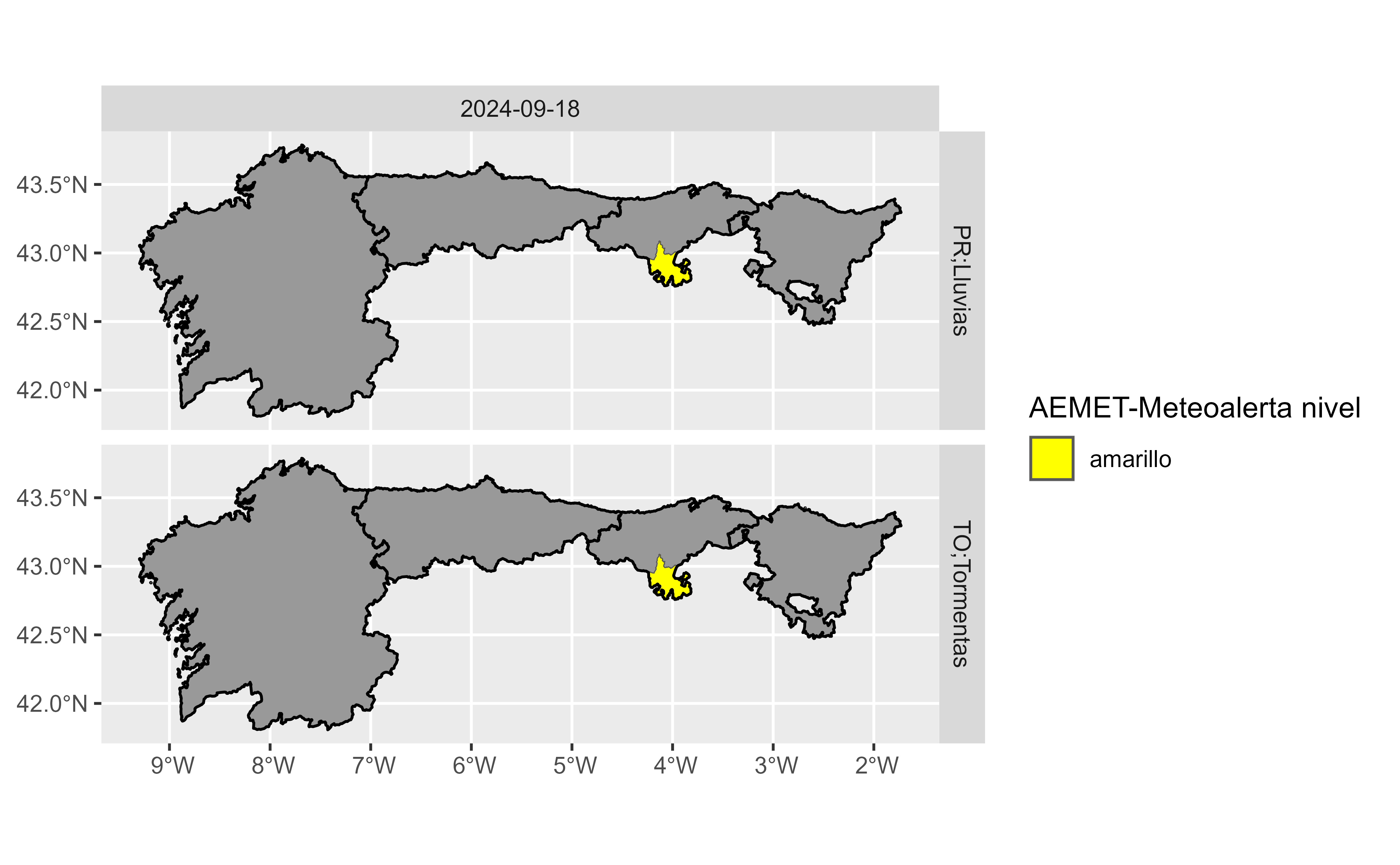
# Base map.
cbasemap <- mapSpain::esp_get_ccaa(ccaa = c(
  "Galicia", "Asturias", "Cantabria",
  "Euskadi"
))

# Alerts.
alerts_north <- aemet_alerts(
  ccaa = c("Galicia", "Asturias", "Cantabria", "Euskadi"),
  return_sf = TRUE
)

# Plot if there are alerts.
if (inherits(alerts_north, "sf")) {
  library(ggplot2)
  library(lubridate)

  alerts_north$day <- date(alerts_north$effective)

  ggplot(alerts_north) +
    geom_sf(data = cbasemap, fill = "grey60") +
    geom_sf(aes(fill = `AEMET-Meteoalerta nivel`)) +
    geom_sf(
      data = cbasemap, fill = "transparent", color = "black",
      linewidth = 0.5
    ) +
    facet_grid(vars(`AEMET-Meteoalerta fenomeno`), vars(day)) +
    scale_fill_manual(values = c(
      "amarillo" = "yellow", naranja = "orange",
      "rojo" = "red"
    ))
}
#>
#> Attaching package: ‘lubridate’
#> The following objects are masked from ‘package:base’:
#>
#>     date, intersect, setdiff, union