
Get boundaries of municipalities in Spain.
Source
CartoBase ANE (Atlas Nacional de España) provided by Instituto Geográfico Nacional (IGN), https://www.ign.es/web/ign/portal. Data are available from 2005 to the present.
Copyright: https://centrodedescargas.cnig.es/CentroDescargas/cartobase-ane
Always acknowledge authorship using the following statements:
When the original digital product is not modified or altered, use one of the following statements:
CartoBase ANE 2006-2024 CC-BY 4.0 ign.es.
CartoBase ANE 2006-2024 CC-BY 4.0 Instituto Geográfico Nacional.
When a new product is generated:
Obra derivada de CartoBase ANE 2006-2024 CC-BY 4.0 ign.es.
Data distributed through the sianedata data branch, see
https://github.com/rOpenSpain/mapSpain/tree/sianedata.
Arguments
- year
Character string or number. Release year. It must use format
YYYY(assuming end of year) orYYYY-MM-DD. Historical information starts as of 2005.- epsg
Character string or number. Projection of the map: 4-digit EPSG code. One of:
"4258": ETRS89."4326": WGS84."3035": ETRS89 / ETRS-LAEA."3857": Pseudo-Mercator.
- cache
Logical. Whether to cache downloaded files. Defaults to
TRUE. See Caching.- update_cache
Logical. If
TRUE, refreshes the cached file and forces a new download. Defaults toFALSE.- cache_dir
Character string. A path to a cache directory. See Caching.
- verbose
A logical value. If
TRUEdisplays informational messages.- resolution
Character string or number. Resolution of the geospatial data. One of:
"10": 1:10 million."6.5": 1:6.5 million."3": 1:3 million.
- region
Optional. A vector of region names, NUTS or ISO codes (see
esp_dict_region_code()).- munic
Character string. A name or
regexexpression with the names of the required municipalities. UseNULLto return all municipalities.- moveCAN
A logical
TRUE/FALSEor a vector of coordinatesc(lat, lon). It places the Canary Islands close to Spain's mainland. Initial position can be adjusted using the vector of coordinates. See Displacing the Canary Islands inesp_move_can().- rawcols
Logical. If
TRUE, retains the raw columns of the resulting object as provided by IGN.
Value
A sf object.
Details
When using region you can use and mix names and NUTS codes (levels 1, 2 or
3), ISO codes (corresponding to level 2 or 3) or "cpro"
(see esp_codelist).
When calling a higher level, such as a province, Autonomous Community, Autonomous City or NUTS 1 region, all municipalities of that level are added.
Note
Although mapSpain supplies cartographically suitable datasets, a historical database of Spanish municipal boundaries is also available, offering higher-resolution geometries that may be more appropriate for GIS-oriented workflows:
Goerlich, F. J. & Pérez Vázquez, P. (2025). Base de datos histórica de contornos municipales de España -LAU2boundaries4Spain- [Data set]. Zenodo. doi:10.5281/zenodo.15345101 , https://www.uv.es/goerlich/Ivie/LAU2boundaries4Spain.html.
Caching
Functions that download data store files in cache_dir. When cache_dir
is NULL, they use the active package cache, which defaults to a temporary
directory. Set update_cache = TRUE to replace an existing cached file.
See Caching strategies in esp_set_cache_dir() to configure a
persistent cache.
See also
CartoBase ANE boundaries and utilities:
esp_get_capimun(),
esp_get_ccaa_siane(),
esp_get_countries_siane(),
esp_get_prov_siane(),
esp_get_spain_siane(),
esp_siane_bulk_download()
Municipality-level datasets:
esp_get_capimun(),
esp_get_munic()
Examples
# \donttest{
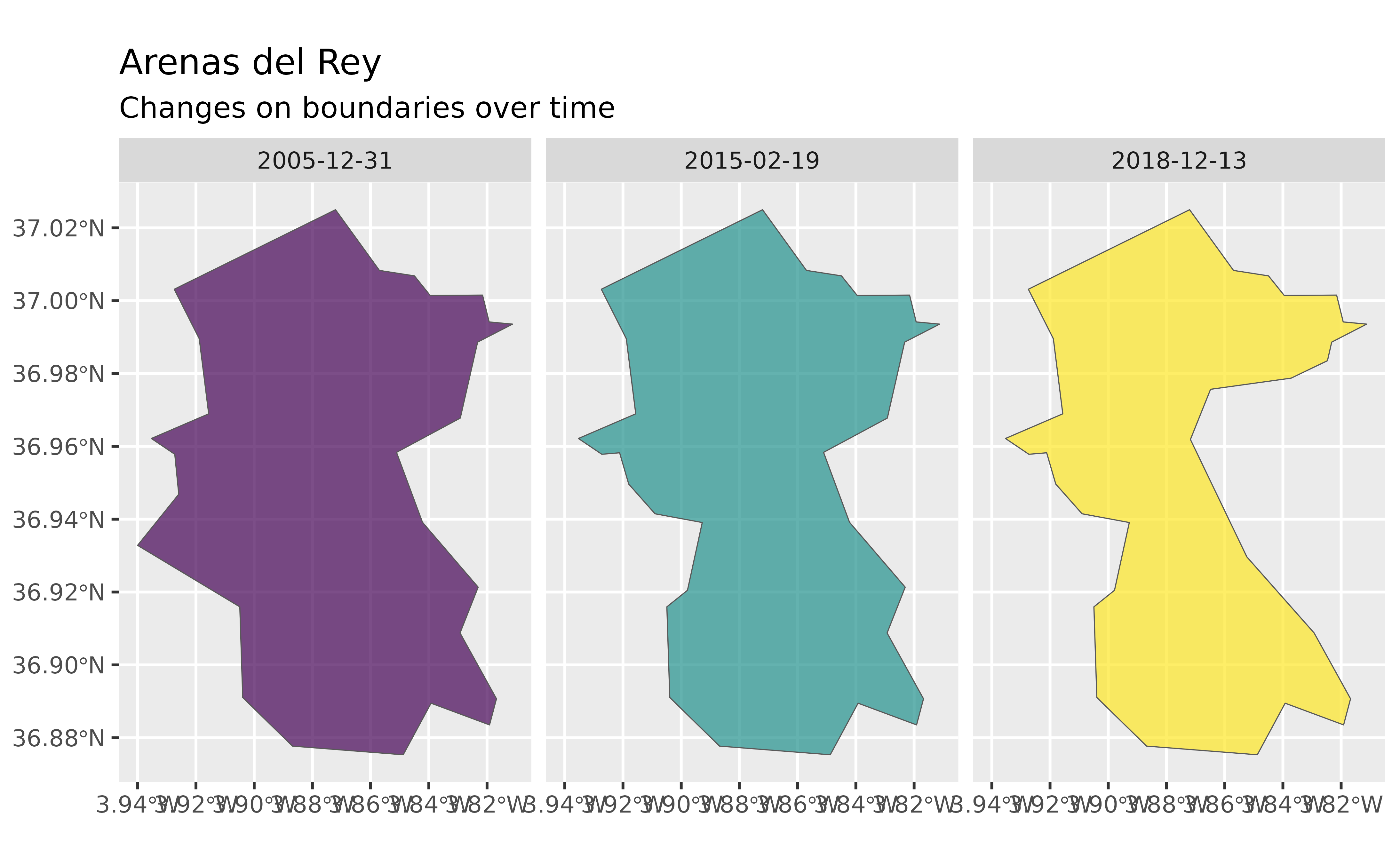
# Municipalities that have changed in the past: three snapshots.
munis2005 <- esp_get_munic_siane(year = 2005, rawcols = TRUE)
munis2015 <- esp_get_munic_siane(year = 2015, rawcols = TRUE)
munis2024 <- esp_get_munic_siane(year = 2024, rawcols = TRUE)
# Manipulate data.
library(dplyr)
#>
#> Attaching package: ‘dplyr’
#> The following objects are masked from ‘package:stats’:
#>
#> filter, lag
#> The following objects are masked from ‘package:base’:
#>
#> intersect, setdiff, setequal, union
allmunis_unique <- bind_rows(munis2005, munis2015, munis2024) |>
distinct()
id_all <- allmunis_unique |>
sf::st_drop_geometry() |>
group_by(id_ine, name) |>
count() |>
ungroup() |>
arrange(desc(n)) |>
slice_head(n = 1) |>
glimpse()
#> Rows: 1
#> Columns: 3
#> $ id_ine <chr> "18020"
#> $ name <chr> "Arenas del Rey"
#> $ n <int> 3
library(ggplot2)
allmunis_unique |>
filter(id_ine == id_all$id_ine) |>
ggplot() +
geom_sf(aes(fill = as.factor(fecha_alta)),
alpha = 0.7,
show.legend = FALSE
) +
scale_fill_viridis_d() +
facet_wrap(~fecha_alta) +
labs(
title = id_all$name,
subtitle = "Boundary changes over time",
fill = ""
)
 # }
# }